“In times of crisis, you need someone to step up and take the lead, and the Omaha Community Foundation stepped up.”
Jill Lynch‑Sosa, Executive Director of the Society of St. Vincent de Paul Omaha, shared those words as survivors, partners, and first responders gathered April 29 to mark two years since the Arbor Day tornadoes. For many in the room, her statement reflected not only the urgency of the days after the storm, but the sustained commitment required long after public attention faded.
On April 26, 2024, multiple EF4 tornadoes cut a 32.5‑mile path across eastern Nebraska, damaging or destroying nearly 1,000 homes in Blair, Bennington, Elkhorn, Kennard, and Waterloo. The scale of destruction made clear early on that recovery would take time, coordination, and trust across agencies, counties, and communities.
A Coordinated Response
In the immediate aftermath, with early support from its board of directors, particularly Gail Graeve of Mutual of Omaha, the Omaha Community Foundation was called into action to support a meaningful and coordinated response. Over the following weeks, that call led to the creation of the Nebraska Tornado Recovery Fund and a broader strategy focused on long‑term recovery rather than short‑term relief alone.
Donna Kush, President and CEO of the Omaha Community Foundation, said that early leadership set the tone for everything that followed. “After raising $1.3 million in donations for the Arbor Day Tornado recovery, OCF established the Nebraska Tornado Recovery Fund,” she said. “This enabled us to convene partners and invest in disaster case management, coalition building, and comprehensive coordination across affected communities.”
Laura Contreras, Senior Program Manager at OCF, emphasized that the response was rooted in neighbors helping neighbors from the start. “They were able to support our community that they all live and work in, and so they wanted to be good neighbors and provide some support,” Contreras said following the commemoration.
The Role of Disaster Case Managers
At the center of the recovery effort were disaster case managers, who served as consistent, trusted guides for survivors navigating complex and often overwhelming decisions. Their work frequently involved sitting at kitchen tables, reviewing insurance policies line by line, helping families avoid fraudulent contractors, and staying engaged long after temporary aid ended.
“This recovery effort was possible because so many partners stayed engaged over the long term and showed up in meaningful ways for survivors,” Contreras said. “From navigating complex cases to meeting immediate needs and building systems that will serve communities in the future, the work reflected a shared commitment to walking alongside neighbors for as long as it took.”
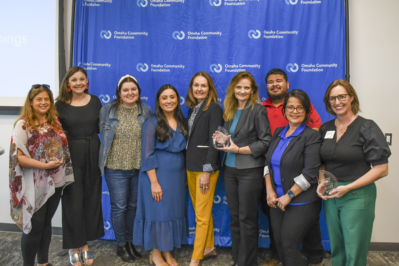
Partners included:
- Christian Outreach Program of Elkhorn (COPE) – Nancy Lary
- East Central Long-Term Recovery Group – Jan Zurcher (not pictured)
- First Lutheran Church of Blair – Erika Cada (not pictured)
- Heartland Hope Mission – Kaylin Behrens, Michelle Rodgers
- Society of Saint Vincent de Paul of Omaha – Jill Lynch-Sosa, Diego Padilla, Lily Reyes
- Meristem Consulting – Sarah Sjolie
Tangible Outcomes and Future Preparedness
That coordination produced results felt both immediately and long term. Recovery partners augmented UNMC’s CASPER survey findings with direct supports for affected neighborhoods. Increased awareness helped leverage a private donation that ultimately covered remaining tornado‑related damage at a local cemetery.
Community clean‑up days in Elkhorn and Washington County supported more than 15 homes, while two tree distribution events helped restore neighborhood tree canopy by providing 350 trees. Partners also facilitated two asset‑mapping events that identified more than 35 physical and people‑based resources Douglas County can draw on during future large‑scale weather events, strengthening local infrastructure for response.
Two years after the storm, the gathering marked the conclusion of a formal recovery effort while recognizing the people and partnerships that made it possible to stay, adapt, and see the work through.